


Dogs · JOINT CARE
4CYTE Granules vs 4CYTE Gel for Dogs: Which One Does Your Dog Actually Need?
If your dog has started taking the stairs one at a time, or you've noticed a stiff, slow unfolding after a nap on the cold tiles, you've probably already found your way to 4CYTE. And then hit the same wall most owners hit: there are two of them.
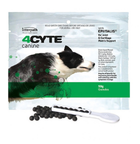
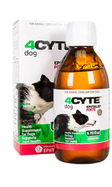
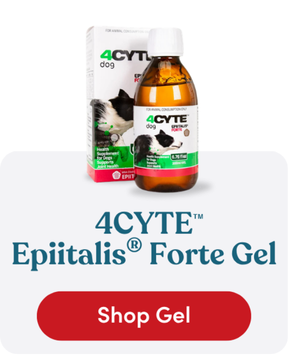
4CYTE Canine Joint Support comes as granules you scoop over dinner. 4CYTE Epiitalis Forte Gel comes as a liquid you pump onto food or straight into your dog's mouth. Same brand, same headline ingredient, very different jobs.
Here's how to tell which one suits your dog — and why plenty of Australian dogs end up on one, then the other, over the course of their life.
4CYTE Canine Joint Support (Granules) vs 4CYTE Epiitalis Forte Gel for Dogs compared
| Always follow the dosing instructions given by your veterinarian. | ||
|---|---|---|
| Format | Granules scooped over food | Liquid gel, given orally or on food |
| Epiitalis concentration | Standard | Higher |
| Other actives | Green-lipped mussel, abalone and marine cartilage | Epiitalis-focused |
| Best for | Ongoing maintenance and prevention | Acute joint issues, injury, post-surgery, visible stiffness |
| Dosing | Loading dose 4 weeks, then maintenance | Single daily dose by weight |
| Typical timeframe | Effective from about 14 days, building over 28 days | Concentrated formula for faster support |
| Sizes | 50g, 100g, 200g, 400g | 50ml, 100ml, 200ml, 400ml |
| Extra benefit | Gut and coat support from the marine blend | Easiest for fussy and small dogs; free of marine ingredients |
| Prescription needed? | No | No |
What both 4CYTE products have in common
Both are built around Epiitalis®, a patented plant seed oil extract. What makes it interesting is the mechanism: rather than simply damping down inflammation, it's patented for its ability to stimulate chondrocytes, the cells that build cartilage. In practical terms, it's aimed at supporting the joint surface itself, not just how your dog feels about walking on it.
Both are daily feed supplements, both are given with or on food, and both are available over the counter with no vet script needed. 4CYTE is made by the Australian-founded company Interpath, and is recommended by vet clinics across Australia.
4CYTE Canine Granules: the everyday maintenance option
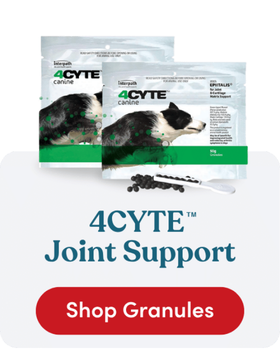
The granules are the original, and the one most dogs start on. Alongside Epiitalis, they contain New Zealand green-lipped mussel, abalone and marine cartilage, a broader marine blend that also supports gut health and coat condition.
How they're given
Dosing works in phases. Start at half the maintenance dose for the first three days so your dog's stomach can adjust, move to a loading dose for four weeks, then drop back to maintenance for the long haul. One scoop is roughly 0.4g, and the amount depends on weight, from half a scoop for a 1-5kg dog up to four scoops for anything over 31kg.
4CYTE's own guidance is that the granules become effective at reducing arthritic symptoms after about 14 days, with continued improvement over 28 days. It's about consistent dosing, not an overnight fix.
Who they suit
- Middle-aged and senior dogs
- Breeds with a known joint risk, such as Labradors, German Shepherds, Rottweilers and Golden Retrievers
- Dogs carrying a bit of extra weight
- Working and highly active dogs, where you're trying to protect the joints before there's a problem
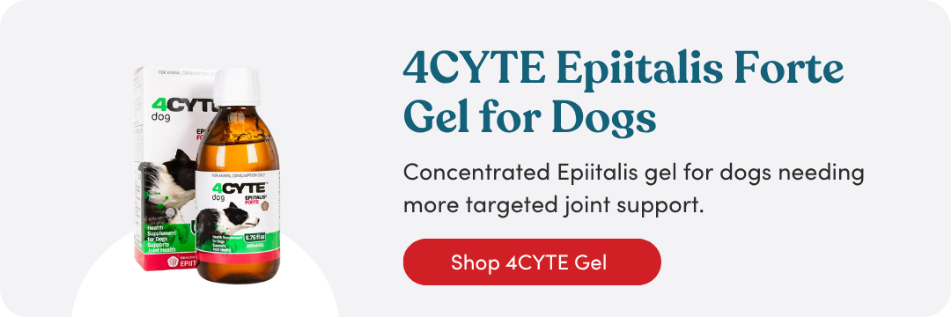
4CYTE Epiitalis Forte Gel: the concentrated option for dogs who need support now
The Epiitalis Forte Gel carries a higher concentration of Epiitalis than the granules, and it's positioned for dogs with more acute needs: joint disease, injury and pain, rather than general maintenance.
How it's given
Dosing is simpler and the volumes are small: 0.5ml for a dog under 10kg, scaling up to 2.5ml for a 40-50kg dog, once daily, either straight into the mouth or mixed through food. There's no loading phase to remember.
Because it's a liquid, it's genuinely handy for fussy dogs, and for small dogs where half a scoop of granules is easy to miss in a bowl. It's also the format many owners find easier to stay consistent with, and consistency is the single biggest factor in whether any joint supplement works.
Who it suits
- Dogs recovering from joint surgery or injury (check timing with your vet)
- Dogs whose stiffness has become obvious rather than subtle
- Older dogs who have slowed noticeably
- Dogs already on a vet-prescribed arthritis plan, where your vet wants added cartilage support
- Fussy eaters and small dogs
- Dogs with marine sensitivities, as the gel doesn't contain the marine ingredients in the granules
How the choice usually gets made
In practice, most Australian vets and pharmacists frame it this way: the gel is for dogs who have a problem now; the granules are for dogs you're protecting from one later.
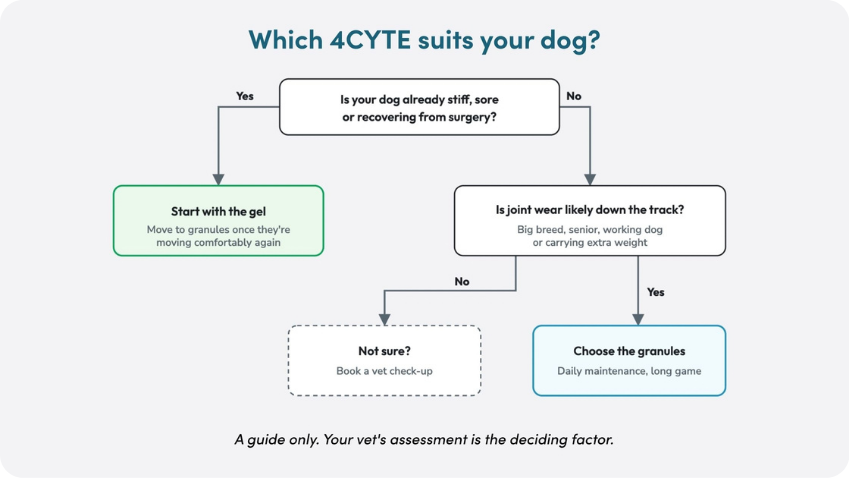
If your dog is already visibly stiff, has been diagnosed with osteoarthritis, or is coming back from a cruciate repair, the concentrated gel is usually the starting point. If your dog is fine but you know the breed, the age or the workload means joint wear is coming, the granules are the sensible long game.
There's also a very common middle path: start on the gel to get on top of things, then transition to granules for ongoing maintenance once your dog is moving comfortably again. Neither product locks you in.
Weight matters too, and it's worth saying plainly that no supplement outperforms getting a heavy dog back to a healthy weight. If your dog is carrying extra kilos, that conversation with your vet will do more for their joints than anything you can put on their dinner.
Signs your dog's joints might be struggling
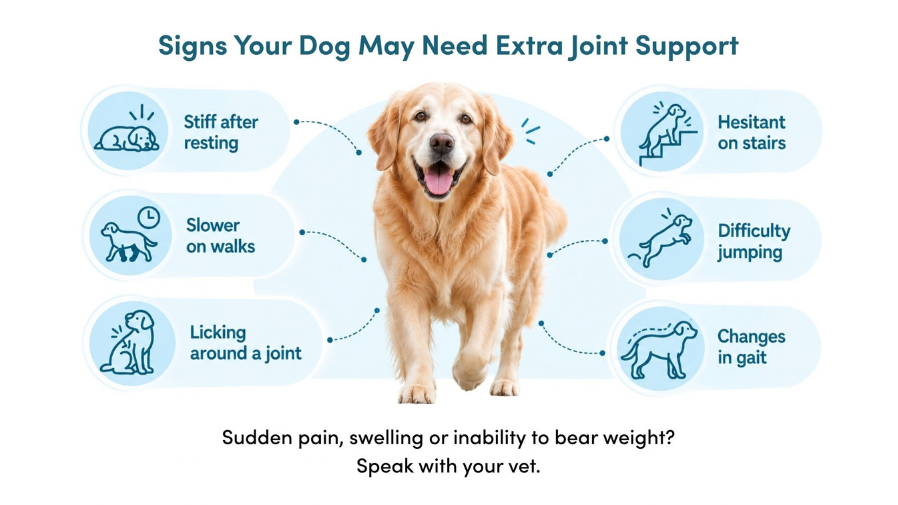
Joint pain in dogs rarely announces itself. It shows up as small changes you might put down to age:
- Stiffness after rest, particularly on cold mornings
- Hesitating at stairs, the car boot, or the couch they used to launch onto
- A shortened, choppy stride, or bunny-hopping with both back legs
- Lagging on walks, or sitting down partway through
- Licking repeatedly at one joint
- Being snappy when touched around the hips, shoulders or knees
- Loss of muscle over the back legs or shoulders
When to see your vet
Your vet will typically assess gait, flex and extend each joint to check range of motion and pain response, compare muscle mass side to side, and may recommend imaging to look at the joint itself. That assessment matters, because limping has a lot of possible causes: a supplement is the right answer for some of them and completely the wrong answer for others.
Always consult your vet before starting any new medication or treatment.
If your dog's lameness came on suddenly, they won't bear weight on a leg, or the joint is hot or swollen, that's a same-day vet visit, not a supplement question.
Giving it every day is the part that matters
Joint supplements only work if they're given every day, which is exactly the kind of thing that slips. AutoShip lets you set a delivery interval and stop thinking about it, and a missed month is the most common reason owners decide a supplement "didn't do anything."
Whether your dog is nine months old with a long future of hard running ahead, or eleven and taking things gently, the right joint support makes a real difference to how comfortable those years are.
The short version
If your dog is stiff now, the gel is usually where you start. If they're well but joint wear is on the horizon, the granules are the long game. Either way, daily consistency matters more than which one you pick, and your vet should be in the loop, especially if your dog is already on arthritis medication.
Not sure where your dog sits on the scale from "slowing down a bit" to "needs help now"? Book a check-up. A five-minute gait assessment will tell you more than any amount of reading.
Common questions
What is the main difference between 4CYTE Granules and 4CYTE Gel?
Concentration and purpose. The Epiitalis Forte Gel contains a higher concentration of Epiitalis and is intended for acute joint disease, injury and pain. The granules contain Epiitalis at a standard concentration plus green-lipped mussel, abalone and marine cartilage, and are designed for ongoing daily maintenance and prevention.
How is it decided which one my dog should be on?
It comes down to whether you are treating a current problem or preventing a future one. Dogs with visible stiffness, a diagnosed joint condition, or post-surgical recovery are generally started on the gel. Dogs who are well but at risk, such as large breeds, seniors, working dogs and overweight dogs, usually go onto granules. Your vet's assessment of your dog's joints is the deciding factor, especially if there is an existing arthritis treatment plan to fit around.
How long does 4CYTE take to work?
4CYTE's guidance for the granules is that they are effective at reducing arthritic symptoms after about 14 days, with continued improvement across 28 days. The gel's higher Epiitalis concentration is formulated to support dogs with more acute needs. Either way, give it a full month before judging the result, and keep dosing daily, because the benefit is cumulative, not immediate.
Can my dog switch from 4CYTE Granules to 4CYTE Gel?
Yes, and it is a common move. Owners often step up to the gel when a dog's joints deteriorate, or step down to granules once an acute episode has settled. There is no washout period needed between the two. Start the new product at its recommended dose for your dog's weight and stop the old one; if you are unsure about overlapping them, check with your vet.
Can I give both 4CYTE Granules and 4CYTE Gel at the same time?
Talk to your vet before doubling up. Both contain Epiitalis, so running them together increases the total daily intake, and that is a decision for someone who knows your dog's full history.
Does my dog need a prescription for 4CYTE?
No. Both 4CYTE products are over-the-counter supplements in Australia and can be ordered directly from Pet Chemist without a vet script.
Can 4CYTE be used alongside my dog's arthritis medication?
4CYTE is designed to complement veterinary treatment rather than replace it, and many dogs are on both. Because your vet is managing the overall plan, let them know what you are adding so they can factor it in.
My dog is fussy. Which 4CYTE format is easier to give?
Most owners find the gel easier. It is a small volume, it can go straight into the mouth if it is being picked around in the bowl, and there is nothing for a clever dog to eat around. Small dogs in particular do well on it, since their granule dose is only half a scoop.
Ready to order?
Explore both 4CYTE options and find the right support for your dog's needs. Both products are available without a prescription.

Pharmacist reviewed by
Melissa Nye, B. Pharm
Co-Founder and COO at Pet Chemist, AHPRA-registered pharmacist
Melissa is a registered pharmacist and Co-Founder of Pet Chemist Online. Passionate about making pet healthcare easier to understand, she combines trusted veterinary and pharmaceutical knowledge with practical, everyday advice to help Australian pet owners keep their dogs and cats healthy and happy.
If you have any concerns about your pet's health, or are starting a new treatment or care routine, always speak with your veterinarian.